Publised on Mar 17, 2026
The Hidden Cost No One Puts in the Budget: Why Scaling Teams Keep Paying the Same Tax

Vicky Lee
In this edition, you'll walk away with:
1) The myth — why great hires don't fix broken processes (and why expecting them to is costing you)
2) The framework — Juran's Triple Role Concept: the quality management tool that explains exactly where ownership breaks down
3) Why scale-up breaks it — what changes between 20 and 100 people that makes the informal system collapse
4) The real cost — four ways the Grey Zone Tax shows up on your bottom line every single month
P.S you can also scroll all the way to the bottom for the key takeaways, and jump to the sections you find most useful 😄
⚡ TL;DR Scaling teams assume great people will just pick up broken processes. They don't — and it's not because they're not trying. It's because process ownership is a real job, and no one assigned it. Here's the framework that explains why, and what it costs you every month it goes unfixed.
👀 The moment I see most often
A founder pulls me in, frustrated.
"We hired really well. Smart people, proven track record. But somehow things still get stuck. Projects drag. Decisions get escalated back to me. I feel like I'm the only one connecting the dots."
So I ask: "Who owns the process between sales and product? Who defines what a completed handover looks like?"
Silence.
Then: "We assumed someone would just... figure it out."
That assumption — that the best person in the room will see the gap and step into it — is one of the most expensive beliefs in a scaling company.
And the cost isn't on anyone's budget spreadsheet.
🚫 The Myth that's Costing You More Than You Think
"If you hire the best people, they'll fix broken processes themselves."
It sounds reasonable. It doesn't work.
When a company scales, new processes don't just appear — they surface. Things that worked informally at 20 people stop working at 50. Handoffs that happened naturally over lunch now require actual structure.
And suddenly, there are gaps everywhere.
The assumption is that a high performer will spot the gap and own the fix.
But "owning a process" is not a personality trait. It's a job. It requires someone to:
Map the full flow — who receives what, from whom, and when
Define what "done" looks like at each stage
Align every team that touches it
Measure whether it's working
Maintain it as the company changes
That is a significant amount of work. On top of someone's actual job.
So your top performers see the gap. They note it. They raise it once, maybe twice. And then — because they're smart — they get back to the work they were hired to do.
The gap stays open.
🧠 The framework that explains why this keeps happening
There's a concept from quality management that every founder should know.
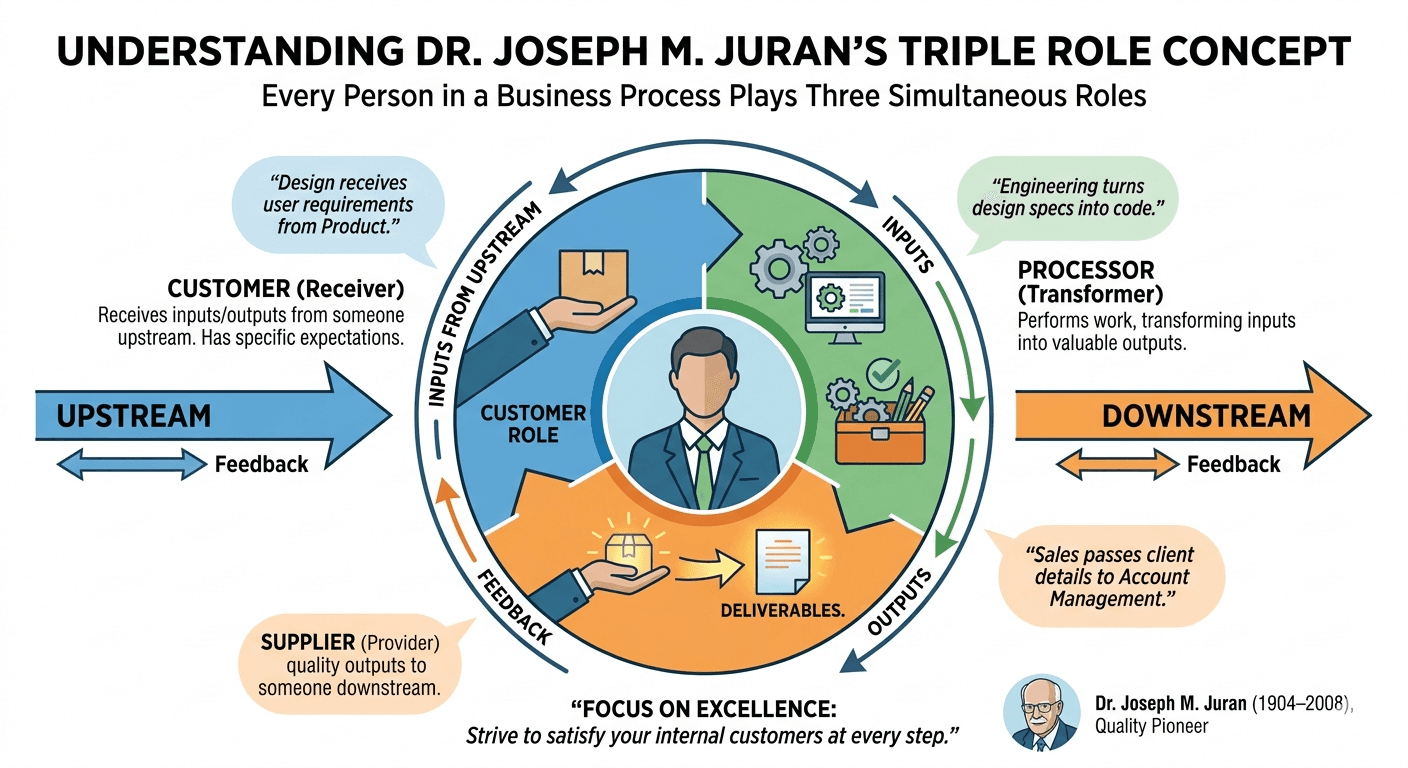
Dr. Joseph M. Juran — one of the fathers of modern quality systems — identified that every person inside a business process plays three roles simultaneously:
📦 Supplier — you provide inputs to someone downstream (e.g. sales passing deal context to onboarding)
⚙️ Processor — you do the work, transforming inputs into outputs
🙋 Customer — you receive outputs from someone upstream, with needs and expectations about what arrives and when
Juran called this the Triple Role Concept.
Every person in a process is simultaneously a supplier, a processor, and a customer — often in the same workflow.
This sounds simple. It isn't.
Because each role comes with real responsibilities:
📦 As a supplier → understand what your downstream customer actually needs — not what you think they need
⚙️ As a processor → know what "good" looks like at your stage, what targets matter, and what metrics signal breakdown
🙋 As a customer → communicate your needs clearly to your suppliers — not assume they'll figure it out
Now ask yourself: in your organisation right now, are those responsibilities clearly assigned?
See content credentials
📉 Why this breaks down specifically during scale-up
At 5-50 people, the Triple Role works informally:
You know the person, you know the context, you fill in the gaps
Everyone was in the room when decisions were made
Institutional knowledge lives in people's heads — and that's fine
At 50-200 people, the informal system collapses:
New joiners didn't build the company — they can't read between the lines
More processes surface, more handoffs emerge, more people enter workflows mid-stream with no context
No one has been given the explicit mandate or time to design how responsibilities should work
What happens instead:
😶 Someone raises the issue in a team meeting. Everyone agrees. No one gets the mandate to fix it.
🔥 The most conscientious person starts informally managing the gap — until they burn out or leave
🆕 A new hire is brought in to "own operations," inheriting a system that was never designed, only accumulated
🔁 The founder stays in the loop on everything, because the loop doesn't close without them
Each of these is a symptom of the same structural gap: responsibilities that exist in theory, assigned to no one in practice.
The chaos isn't random. It's structural.
💸 What this actually costs per month
This is the part founders don't budget for — because the cost is invisible until it isn't.
Cost 1: Delayed time to revenue
Think about your slowest key process right now. Client onboarding. Project delivery. Feature shipping.
Every week that process drags is revenue delayed
A client onboarding that takes 6 weeks instead of 3, on a £12,000/month contract = £6,000 lost per client
Across five clients in a quarter = £30,000 sitting in a grey zone
Not because of market conditions. Because no one designed the handoff.
Cost 2: Internal efficiency drain
Every employee has a finite number of high-quality working hours per week.
When those hours go toward:
🔍 Chasing status updates
🔁 Re-explaining context
❓ Figuring out who owns what
🔧 Redoing work that arrived incomplete
...that's capacity permanently lost. It doesn't show up in a report. But it's happening every single day.
Cost 3: Top performers quietly deciding to leave
Organisational chaos is most painful for your best people:
They can see the problem
They care about the outcome
They burn out faster because they try harder — before eventually giving up
The ones who stay longest in broken systems are often not your best people. They're the ones most tolerant of ambiguity.
Replacing a senior team member — recruiting, onboarding, ramp time — typically runs 50–200% of their annual salary.
That's the hidden exit cost of a broken operating system.
Cost 4: The compounding trust deficit
When processes break down visibly — missed handoffs, dropped context, repeated escalations:
Employees lose confidence in leadership's ability to manage at scale
Not in the founder as a person — in the organisation as a place where good work is possible
Satisfaction drops. Productivity follows. The founder works harder, not less.
This is what I call the Grey Zone Tax — the accumulated cost of all the decisions, handoffs, and responsibilities that exist in your organisation but haven't been explicitly assigned to anyone.
It compounds quietly. And it shows up as exhaustion before it shows up as a line item.
🔧 The fix isn't hiring more people
The instinct is to add capacity. Another project manager. A head of operations. Someone to "own this."
Sometimes that's right. Often it isn't.
The real question is: do you have a process architecture problem or a headcount problem?
Adding a person into an unclear system doesn't fix it. It just gives the chaos a new owner.
The fix starts upstream. Before the hire. Before the restructure. Before the next all-hands on "accountability."
It starts by asking:
Who is the supplier in this process?
Who is the processor?
Who is the customer?
Do all three know what's expected of them?
If you can't answer that cleanly for your three most critical workflows — that's where the work is.
💬 So what does fixing this actually look like?
That's a bigger question than one newsletter can answer well.
It depends on:
Where the grey zones are sitting in your organisation
Which processes are costing you the most
How far into scale-up you are and what's already been tried
But it starts with one question: do you know where your Triple Role gaps are?
Reply and tell me: which part of your organisation feels most stuck right now?
Handoffs between teams?
Ownership of new processes?
Escalations that keep coming back to you?
I'll use your answers to shape the next edition.
🎁 Free resources to start with
👉 Before You Hire: An Organisational Diagnostic for Growing Teams — the free diagnostic I walk through in the first week of any engagement. Start here if you're trying to figure out whether you have a headcount problem or an architecture problem.
👉 Book a 30-minute call — if you'd rather talk through what you're seeing in your org. No pitch. Just diagnosis.
📌 Key Takeaways
💡 Great people don't automatically fix broken processes — process ownership is a distinct job, not a personality trait
🔁 Every person in a workflow plays three roles: supplier, processor, customer — each with real responsibilities
📈 Grey zones surface predictably during scale-up — they're structural, not random
💸 The Grey Zone Tax is real: delayed revenue, efficiency drain, top performer attrition, eroding trust
🔍 The fix starts with the right diagnosis — before the next hire, before the next restructure
Vicky Lee is the founder of Growing Roots Lab, an operational architecture consultancy for growth-stage teams in tech-enabled businesses. She works with founders and leadership teams to diagnose and redesign the invisible systems that shape how their organisations actually function.