Publised on Mar 10, 2026
Every Scaling Company Hits This Wall. Most Mistake It for a Hiring Problem.

Vicky Lee
IN TODAY'S EDITION, YOU WILL WALK AWAY WITH:
A pattern to recognise. Why the chaos you're feeling at 50–100 people isn't random — it follows a six-stage model that has predicted organisational breaking points since 1972. Once you see it, you can't unsee it.
A reframe that might save you a bad hire. The difference between a capacity problem and a structural one — and why confusing the two is one of the most expensive mistakes a scaling company makes.
Three signals to watch for. The specific, observable ways a team's invisible operating system starts to break — in how people communicate, how decisions get made, and what happens when you ask "what's wrong?"
A free diagnostic tool. A four-step process to map what's actually breaking in your organisation — with interview prompts, a decision-mapping framework, and a worked example. Download the link at the end of this edition.
THE MOMENT IT STARTS
The Head of Customer Success was doing three jobs at once — and honestly, it was working.
Managing the team. Defining strategy. Being the connective tissue between CS and every other function: product, sales, ops. At 30 people, this was just leadership. Informal, fast, effective. Everyone knew where to go when something was unclear. Because the answer was always: go find her.
Then the client pipeline doubled.
Suddenly the same three jobs weighed three times as much. More clients meant more escalations. More escalations meant less time for strategy. Less time for strategy meant the cross-functional coordination started slipping — and when cross-functional coordination slips, other team leads stop getting responses. They fill the gap with assumptions. Assumptions harden into separate realities.
So the Head of CS did what any reasonable leader would do. She asked to hire someone.
Maybe a Team Lead to take over people management. Maybe a CS Operations person to own the workflows. Maybe a senior IC who could "partner with other teams" — so she wouldn't have to attend every cross-functional sync herself.
Does this sound familiar? Maybe it's your Head of Sales. Your VP of Product. Your COO. Maybe it's you.
Here is the question I want to sit with you on, before you approve that headcount:
Are you solving a capacity problem — or are you about to hire around a structural one?
THE PATTERN BEHIND THE CHAOS
What the Head of CS experienced isn't unique to her. It isn't a management failure or a talent gap. It follows a pattern that organizational psychologist Larry Greiner mapped in 1972 — and that I have watched play out, with remarkable consistency, inside every scaling company I've worked with since.
Greiner's model describes six phases of organizational growth.
Each phase works, until it doesn't.
Each phase ends not with a failure, but with a crisis — a structural tension that the previous way of operating simply cannot resolve.
Stage 01 — Creativity
Flat structure. Founders in every decision. Communication is informal and fast. Employees rewarded with ownership over salary.
Crisis — Leadership: Founders feel burdened by management. Bottlenecks appear everywhere. No one can keep track of all operations.
Stage 02 — Direction
Functional structure. Specialized roles. Formal accounting. Top management adopts a directive style; communication turns hierarchical.
Crisis — Autonomy: Middle managers feel like puppets. People with direct market knowledge feel restricted and start to disengage.
Stage 03 — Delegation
Authority decentralized to business unit managers. Profit centers. Individual bonuses. Top executives manage by exception.
Crisis — Control: Units head in different directions. Duplication appears. Strategic drift. Central alignment quietly breaks down.
Stage 04 — Coordination
Formal coordination systems. Merged product groups. HQ staff running company-wide reviews. Profit sharing to foster alignment.
Crisis — Red Tape: Procedures take over problem-solving. Line managers fight HQ staff. The org becomes too rigid to respond to the market.
Stage 05 — Collaboration
Simplified systems. Matrix structures. Interdisciplinary teams. Focus on self-discipline and social control over rigid rules.
Crisis — Saturation: People become emotionally and physically exhausted. Constant teamwork and innovation pressure becomes unsustainable.
Stage 06 — Alliances
Growth driven externally through mergers, partnerships, global networks. Holding company structure manages diverse entities.
Crisis — Identity: Unified vision splinters. Partner goals conflict. The company loses sight of its own customers and core business.
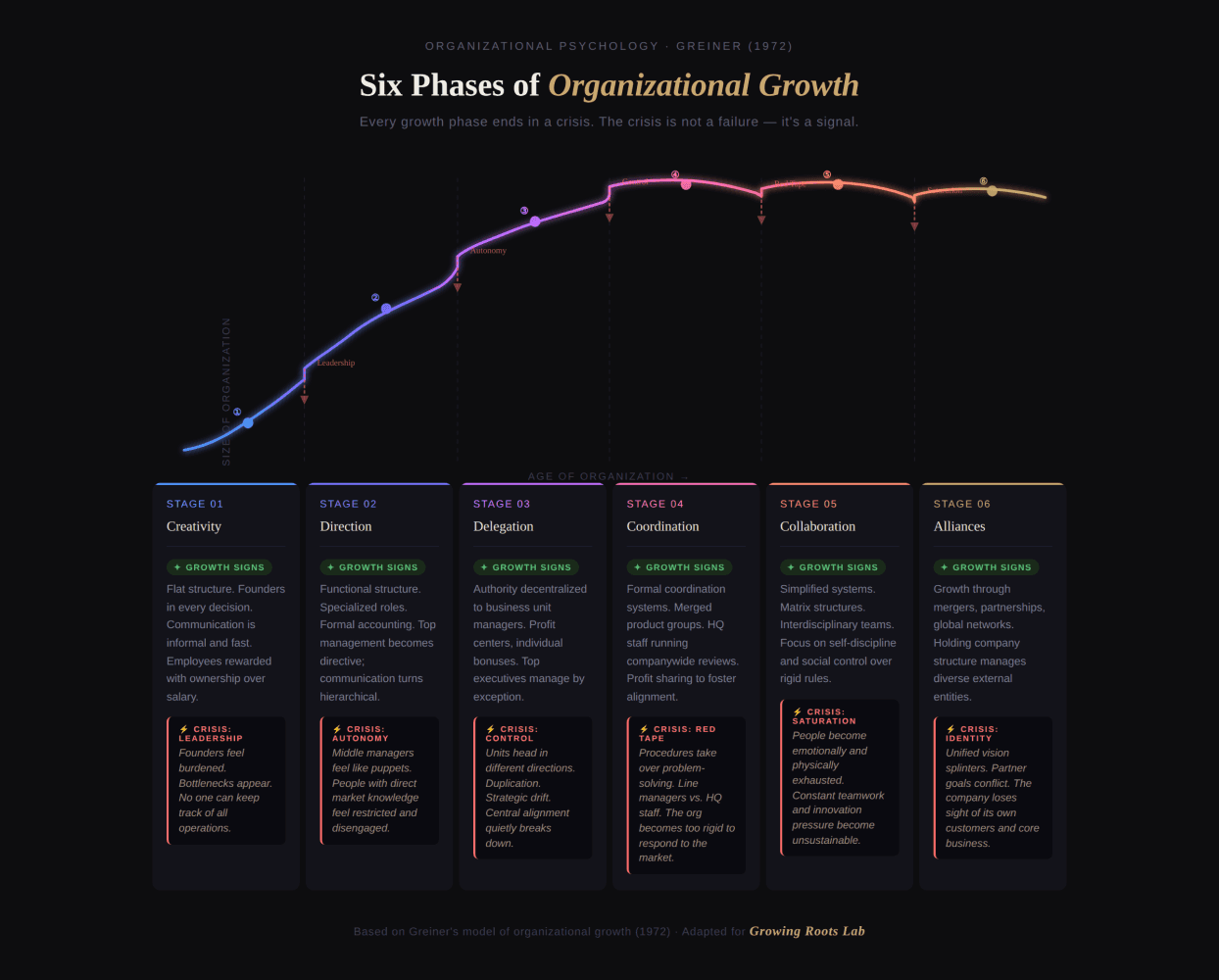
The Greiner's Curve - 6 Phases of Organizational Growth
Most growth-stage SaaS companies I work with are moving from Stage 2 into Stage 3 — the moment where centralized direction has to give way to delegation. The Head of CS story? That is the Autonomy Crisis arriving in real time. Middle managers and senior ICs have outgrown the top-down flow of information. They need room to operate. But the operating system hasn't been redesigned to give it to them.
The informal operating system worked at 20 people because it was invisible in the right way. Nobody needed to see it — it just ran. At 50, it becomes invisible for a different reason. Nobody can find it anymore.
WHAT'S ACTUALLY BREAKING - 3 PATTERNS
When I go inside a scaling team at this inflection point, I see three patterns with near-perfect consistency. Not in one or two companies — in almost all of them.
1. Communication slows, then goes passive-aggressive
Slack messages get more polite as teams get more careful. Long disclaimers appear before hard truths. "Just wanted to flag..." becomes the opening line of every difficult update. Nobody says what they mean directly anymore — because they're not sure who's watching, or what the right politics are.
The irony is that the team looks more professional from the outside. Internally, it has slowed to a crawl. The information that used to travel in two minutes over lunch now takes two days, three meetings, and a Notion doc that nobody finishes reading.
2. Every decision requires the founding team
What used to be a product call now has a VP in the room. Not because anyone asked for it — but because people aren't sure where their authority ends and someone else's begins. The grey zone has appeared. And nobody owns the grey zone.
This is the part that exhausts your best people. Not the work itself. The navigation. Senior engineers spending 30% of their week in alignment meetings. PMs holding three syncs to make one decision. Founders being pulled into conversations that should have been resolved two levels below them — but couldn't be, because the system for resolving them doesn't exist yet.
3. Nobody can articulate what's wrong
Ask your team what the problem is. You'll get three different answers — none of them quite right, all of them pointing at the same thing from different angles. "It feels different." "We used to move faster." "I'm not sure who decides things anymore."
This is not a vague feeling. It is a precise signal. The operating system has become invisible in the wrong way — and the people living inside it don't have the language to name what's missing. They only know something is.
When the best people start saying "the culture has changed" — they are not complaining about culture. They are describing structural confusion, expressed the only way they know how.
WHAT HAPPENS WHEN YOU HIRE INTO THIS
A new hire doesn't enter a clean system. They enter a grey zone and have to navigate it without a map.
They take up context bandwidth from your best people during ramp-up — at the exact moment your best people are already overextended navigating the structural confusion. They absorb the dysfunction as if it were normal, because they have no prior reference point for how this company used to work. And if the role is specifically designed to bridge the grey zone — as a Team Lead, Ops hire, or cross-functional representative often is — they will inherit the ambiguity rather than resolve it.
Hiring into an undefined system is like adding passengers to a car with a broken steering wheel. More horsepower doesn't fix the navigation problem.
I've watched this play out most acutely with CS and Sales operations hires. A Head of CS brings on someone to "handle the cross-functional coordination" — but there's no defined decision map for what that person is actually empowered to decide. So they attend the meetings. They take notes. They circulate summaries. And six months later, the Head of CS is still the one making every call, just with more calendar invites and an extra salary on the books.
The structure didn't change. It just got more expensive.
BEFORE YOU HIRE: A DIAGNOSTIC TO RUN FIRST
Most leaders I work with know something is broken. What they're missing is a structured way to see it clearly — before they make a hiring decision that papers over the real problem.
The diagnostic I use with clients moves through four steps: interviewing the people who actually manage the workflows (not the org chart), drawing the real decision map, finding where work silently disappears between teams, and sorting each blocker by whether it needs a conversation, a process, or a person.
Most of the time, the answer is not a person.
If you're at the stage where any of the three patterns above sound familiar, this is the right place to start — before the job description, before the recruiter call, before the headcount approval.
Download the Full Diagnosis ⬇️
https://vickyleeops.gumroad.com/l/operationadiagnosis (P.S. You have to copy & paste this link in your browser)
WHAT OPERATIONAL ARCHITECTURE ACTUALLY IS
Operational excellence isn't a department. It isn't a COO or an Agile coach or a project management tool. It is the answer to one question:
Do the people in your company share an understanding of how work actually happens here?
If the answer is no — if your teams are operating on different invisible assumptions about who decides, who owns, who escalates — no new hire will fix that. They'll just add another person navigating the fog.
The informal operating system that got you to where you are deserves to be seen clearly before it's replaced. Not because it's sacred — but because you can't redesign what you can't see.
Before your next hire, spend two weeks making the invisible visible. You might be surprised what you find — and what you no longer need.
🌱 Follow to get weekly insights to navigate the messy reality of scaling.
🌱 - Vicky, Growing Roots Lab